

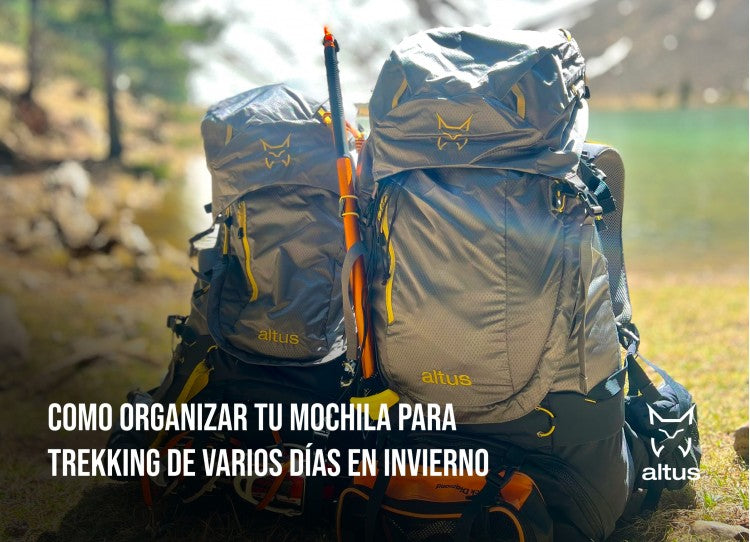
Are you looking forward to winter? Do you love winter routes with snowy landscapes and fresh air? But do you not know how to pack your backpack for this season? Do you carry layer after layer and do not know how to store everything to optimize space?
Don't worry, we have the solution to this problem, stay on this blog and become an expert at organizing your backpack for winter trekking.
The importance of good organization in winter
Organizing your backpack well is not only a matter of comfort but also a matter of safety that in winter can make the difference.
Weather conditions are more changeable at this time, terrains can get complicated with rain, mud or snow, and having quick access to your equipment can be key.
That is why, good organization allows you to:
• Easily access the essentials without making a mess or having to waste time while getting wet or cold.
• Maintain balance while walking, distributing the weight correctly.
• Protect the material from water and cold.
• Optimize space to make the most of it.
Choose the right backpack for winter trekking
Before thinking about how to organize it, make sure your backpack is the right one, as not all are designed for the demands of winter.
You will need to consider three key factors when choosing it:
Opening type
The opening type determines how you will access your equipment and how you will have to organize it to always have what you need at hand, among the different types of openings we find the following:
• U-opening: very useful to comfortably access practically all your equipment without the need to remove part of it, you can find it in backpacks like Lhotse 50 I30 and lhotse 65+5l.
• Vertical zipper opening: this access allows you to open the backpack from the front and access the interior easily, you can find it in models like Fitz Roy 25 J30 and Fitz Roy 45 J 30.
• Top opening with bellows closure, cord and buckle: This is the most common opening system in mountain backpacks, you will be able to find it in models like Pirineos J30 in all its literages.
• Back opening: This innovative opening system will allow you to comfortably access all your belongings from the back, you will be able to remove everything you need without the need to disorganize your equipment, you will be able to find it in models like the Saioa model.
• Classic opening (inverted U): it is the most common opening in daypack backpacks, that is, backpacks designed for day trips, you will be able to find it in models like Denon J30 .
Literage: size does matter
Before using one backpack or another on your next adventure it is essential to understand what you are going to use it for, you will have to choose it depending on the duration of your route.
• Day routes (20-30L): ideal for short crossings, where you only need to carry the essentials, for example, food, water, a layer of warmth and some technical material.
o Recommended models: Fitz Roy 25 J30 and Saioa .
• Multi-day routes (+30L): prepared for weekend crossings or more days, where you will have to carry additional clothing, camping equipment and safety accessories.
o Recommended models: we recommend the previously mentioned Lhotse, Marbore or Pirineos, depending on the duration of your adventure you will have to choose one or the other.
Backpack covers and protection against water
In winter, the probability of rain or snow is much higher, so a backpack cover is essential.
Remember that backpacks are water-repellent, not waterproof, so even a light rain for a few minutes can wet all your equipment, anyway, if you have any doubt about the differences between water repellency and waterproofing you can always consult our blog ¨Waterproofing vs repellency: keys to choosing the right mountain clothing and equipment¨.
Choose the right backpack cover according to the literage of your model, since not all fit all backpacks equally:
If you are looking for one for a 20-30 liter backpack we recommend size S, for a 30-50 liter backpack size M and for a 50-70 liter backpack size L.
Essential accessories for the winter season
On winter routes, where the mountain can present more challenges and extreme conditions, being well equipped is essential. Depending on the terrain and the difficulty of the area you are going to travel, there are certain elements that cannot be missing from your backpack:
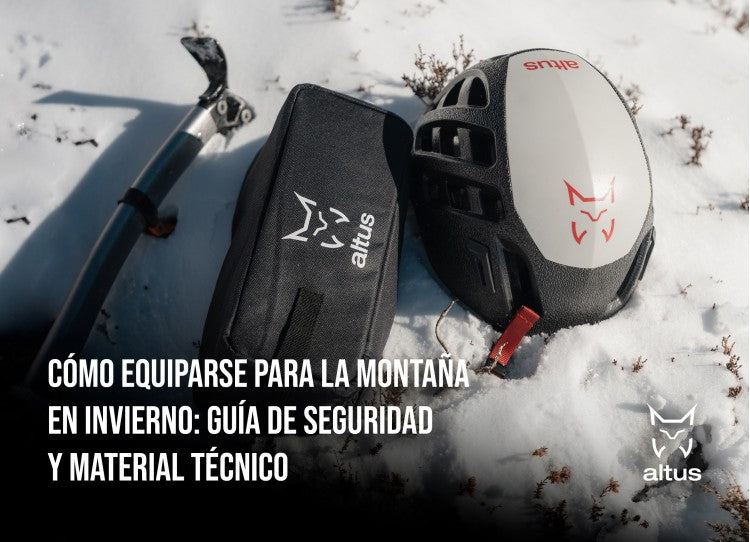
• Ice axe holder: fundamental if there is snow or ice.
• Pole holder: useful to store them when you do not use them.
• Anchor straps: for snowshoes or board.
• Ski holder: if you do ski touring.
• Crampon compartment: which must be isolated from the rest of the material to avoid damage.

Weight distribution: what to carry on top, in the middle and at the bottom
Knowing how to distribute the weight is key to maintaining balance and avoiding overloading the back, this way you will avoid possible injuries.
If you follow this rule, you will achieve the best distribution for your backpack:
Place the heaviest items in the lower area and as close as possible to the back. In contrast, those lighter things should go in the upper area of the backpack and as far as possible from the back.
Clothing and layering system: how to store them for easy access
Winter requires being prepared for sudden changes in temperature or weather, that is why it is essential to have the right garments at hand, that is why, at Altus we recommend following these tips:
- Store waterproof or windproof garments near the main openings or in external pockets.
- If you are going in a group, place them in a place where your companions can help you get them without opening the main compartment
- Layering system: organize from the base layer (thermal) to the outer layer (waterproof) in a logical way to dress according to the weather.
Thus, you will always be ready to act without wasting time or exposing your equipment to the cold or moisture.
Food and hydration: where to place the food and water
In the mountains, staying hydrated and energized is as important as dressing well, each one has their way of organizing their provisions but we recommend the following way:
Place the water in the side mesh pockets, to always have it at hand and in case of having a hydration bladder, if the backpack allows it, place it hanging in the area designated for it.
Place the snacks and light food in the upper or side pockets to snack without stopping.
Heavier meals or utensils in the central compartment, near the back, to balance the weight.
Camping and rest equipment: sleeping bag, mat and basic accessories
When the adventure lasts several days, sleeping well and keeping the equipment dry is essential.
Some practical tips:
• Sleeping bag: place it in the lower compartment if your backpack allows it.
• Sleeping mat: If it is foldable/rollable, carry it attached to the sides or at the bottom with the compression straps, you can choose between the models Zig Zag Insulated Sleeping Mat or K30 Solid Color Pyramid Mat. If it is self-inflating, better inside the main compartment due to its size and fragility, such as the model Autohinchable Pad-4 J30
Tip: Extra protection: carry with you a light plastic or to place on the ground when camping or taking things out on wet terrain.
• Dry bags: Use several to protect clothing and sensitive objects from moisture or mud, we highlight our models Balces 10 L and 20 L
Safety accessories and first aid in winter
The mountain is a place where you have to be prepared for everything and more in winter, if you are going to pass through snowy or icy areas do not hesitate to always carry the following equipment with you:
• Crampons
• Probe and shovel
• Headlamp with spare batteries, knife and whistle
Final tips for organizing your winter trekking backpack
Organizing your backpack correctly may seem like a minor detail, but it makes the difference in your routes, that is why we have prepared a series of tips that can help you:
• Choose the right backpack according to the type of route and winter conditions.
• Distribute the weight evenly, with the heavy items near the back.
• Keep the layers and waterproof garments at hand for weather changes.
• Keep the water and snacks accessible and protect the rest of the equipment with dry bags.
• Make sure to carry safety material and know its use.