

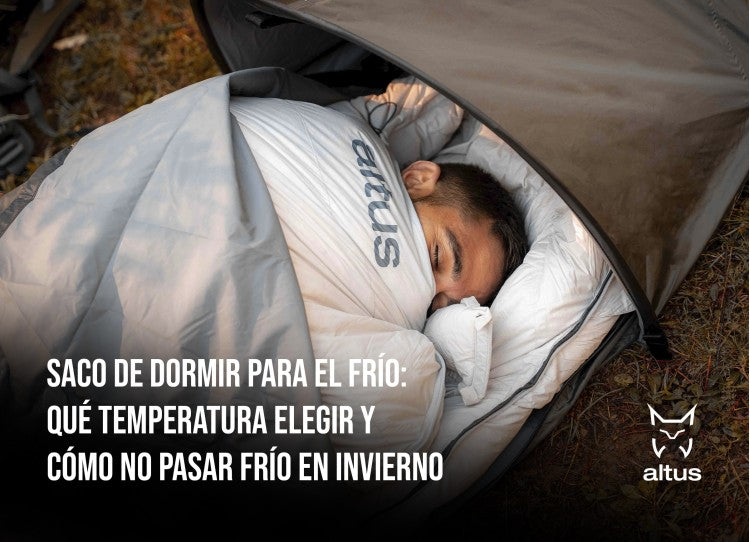
When temperatures start to drop, a very common question arises: what sleeping bag do I really need to stay warm?
The answer seems simple until we look at a technical spec sheet and find several figures: comfort, limit, extreme… Which one should we consider? If the forecast calls for 0 °C, do we need a 0-degree sleeping bag? And what exactly does it mean when we talk about a -5 or -10 °C sleeping bag?
Choosing the right sleeping bag for winter does not mean looking for the lowest possible figure.
The first thing is to understand what each temperature represents and then assess the actual conditions in which we will be sleeping: ground insulation, humidity, shelter, personal sensitivity to cold, or type of activity.
Because a sleeping bag does not work alone.
To sleep comfortably when it is cold, we need the entire sleep system to work together
How to read a sleeping bag's temperature: comfort, limit, and extreme
One of the most common mistakes when choosing sleeping bags is interpreting the lowest temperature on the label as the one at which we can sleep comfortably.
That is not the case.
Technical sleeping bags can show several temperature ratings obtained through standardized methods. Each represents a different situation, and it is best to understand them before comparing models.
The sleeping bag's comfort temperature is the most useful reference when we want to plan a night with comfortable rest in mind.
The limit temperature represents more demanding conditions. We should not interpret it as our ideal operating temperature, but rather as a level at which the comfort margin is already much smaller.
Finally, the extreme temperature corresponds to an emergency situation and should not be used as a reference for planning a normal night.
Let's take a simple example.
If we find a sleeping bag with:
- comfort: 0 °C;
- limit: -5 °C;
- extreme: -15 °C;
we should not consider it a “-15 °C bag” thinking that we will sleep comfortably at that temperature.
To decide if it fits our trip, our first look should be at the comfort temperature.
And even so, that figure does not work as an absolute guarantee.
Everyone has a different sensitivity to cold, and external conditions, fatigue, humidity, or ground insulation can greatly change our sensation during the night.
That is why, when we talk about the temperature of a sleeping bag, we should understand it as a reference within a broader system.
What sleeping bag you need according to the temperature
Knowing how to interpret the figures is the first step.
The next is applying them to a real situation.
In the following scenarios, we will talk about 0 °C, -5 °C, or -10 °C taking as a reference the comfort temperature we are looking for, not simply the lowest figure associated with the bag.
It is also advisable to avoid an overly rigid equivalence.
If the forecast indicates a low of -5 °C, automatically choosing a bag whose comfort is exactly -5 °C leaves us little margin if the night turns out colder than expected or if we are especially sensitive to cold.
We should always assess:
- forecasted minimum temperature;
- altitude;
- humidity;
- type of shelter;
- sleeping pad insulation;
- duration of the trip;
- fatigue;
- and our own thermal sensitivity.
0-degree sleeping bag: autumn and nights in a shelter
A 0-degree sleeping bag, understood as a model with a comfort temperature close to that value, can fit many cold autumn nights or certain overnight stays in a shelter.
It can also be sufficient for shoulder-season trips in which we expect low nighttime temperatures but not a proper winter scenario.
The important thing is not to use the season as the sole reference.
An autumn night at low altitude can be relatively mild, while another at higher altitude can quickly approach sub-zero temperatures.
That is why, in addition to the forecast, we must assess where we will sleep and what insulation we will have from the ground.
If conditions approach 0 °C, having a certain margin relative to our comfort temperature can help us deal with variations during the night.
Within our range, models like the Tibet 1100 K30, with a comfort temperature of +2 °C, can meet cold shoulder-season nights when conditions and the rest of the sleep system are adequate.
-5 °C sleeping bag: first winter trips
When we start moving in sub-zero temperatures, the margin becomes even more important.
A -5 °C comfort sleeping bag can be suitable for certain first winter trips or cold nights in which we know the temperature will clearly drop below zero.
In this range we can find options like the Andes 900 K30, with a comfort temperature of -3 °C, designed for clearly colder conditions.
But at these temperatures it starts to become especially evident that the bag cannot compensate on its own for a poorly planned sleep system.
We can carry a bag with a good thermal capacity and still feel cold if we sleep on a sleeping pad with insufficient insulation or accumulate moisture inside.
Other details also become more important:
- keeping clothes dry;
- protecting the bag from moisture;
- preparing the place before temperatures drop too low;
- and letting the fill recover its volume before going to bed.
As the thermometer drops, the importance of everything surrounding the bag also increases.
-10 °C or lower sleeping bag: harsh winter and high mountains
When we enter temperatures of -10 °C or lower, we are already talking about clearly more demanding scenarios.
Here the choice should not be based solely on finding a bag whose spec sheet shows a certain figure.
Aspects start to carry much more weight such as:
- type and amount of fill;
- construction;
- ground insulation;
- weight;
- compression capacity;
- moisture protection;
- shelter;
- user experience;
- and margin relative to the forecasted conditions.
When we look for comfort at temperatures of -10 °C or lower, we are already entering another level of protection. One example is the Andes 1500 K30, with a comfort temperature of -12 °C.
In this type of trip, every element of the system is more important because there is also less margin for error.
If you are preparing especially cold nights or high mountain trips, you can expand this information in our guide to choosing the best sleeping bags for high mountains, where we go into more detail about the purchasing criteria for this type of activity.
Here temperature is still important, but it is no longer sufficient on its own.
Down or fiber when temperatures drop
Another common question when looking for a bag for the cold is whether it is best to choose down or synthetic fiber.
There is no universal answer.
Down sleeping bags usually stand out for their relationship between insulation, weight, and volume. This makes them especially interesting when we need to carry the bag for several days and want to reduce the space it takes up inside the backpack.
They can also achieve high levels of insulation with a good compression capacity.
In exchange, we must pay special attention to moisture and the care of the fill to properly preserve its performance.
Fiber sleeping bags offer a different performance.
Synthetic fiber is usually practical when we expect wetter conditions or when we prioritize easy maintenance. Depending on its construction, it may involve a bit more weight or volume to achieve certain thermal performance.
But it would be a mistake to think:
“Down for cold and fiber for mild temperatures.”
We can find bags of both types designed for different thermal ranges.
The choice depends on how we are going to use them.
If weight and compressibility are priorities, down can offer clear advantages. If we expect moisture or are looking for a simple and resistant alternative for other types of trips, fiber can make a lot of sense.
That is why, before deciding between down or fiber, we must return to the initial question:
In what conditions are we going to sleep?
Weight and volume: how much warmth fits in your backpack
The more insulation we need, the more important it becomes to find a balance between thermal capacity, weight, and volume.
A bag designed for a mild night can be light and take up very little space.
When we look to sleep comfortably below zero, we need more insulation capacity and a construction designed to retain heat better.
The consequence is that, generally, the bag will be more voluminous or require materials capable of offering a good relationship between insulation and weight.
And here the type of activity greatly changes our decision.
It is not the same to sleep in a campsite we arrive at by car as to carry all our equipment in a backpack for several days.
On a trek, every gram and every liter counts.
That is why, the warmest bag available is not always automatically the best for our trip.
We need sufficient thermal protection, yes, but also equipment we can carry and that fits with the rest of the gear.
The balance is to carry the insulation we really need without carrying performance we are not going to use.
Hood, draft collar, and zipper: the details that retain heat
The comfort temperature gives us a fundamental reference, but the design of the bag also influences our experience during a cold night.
When temperatures drop, small details help limit the escape of hot air that our body has generated inside the bag.
The hood is one of them.
In the models that incorporate it, adjusting it correctly helps to better protect the area of the head and neck and to reduce the entry of cold air.
We can also find thermal draft collars in bags designed for lower temperatures. Their function is to create an additional barrier around the upper area of the body and limit the exchange of air between the inside and the outside.
The zipper also matters.
In some models we find flaps or insulating elements that help reduce the loss of heat in an area that can become a weak point of the construction.
And, of course, we must use all those elements correctly.
A completely open hood or a zipper we leave partially unzipped can greatly change our thermal sensation when the outside temperature drops.
A good bag should not only have insulation capacity.
It also has to help us retain the hot air that our body generates inside it.
How not to feel cold inside the bag: sleeping pad, liner, and bivvy bag
When we feel cold during the night, our first reaction is usually to think that we need a warmer bag.
But the problem is not always there.
We can have a good bag and lose a large part of the comfort if the insulation relative to the ground is insufficient, the equipment is damp, or the exterior system does not respond to the conditions.
The insulated sleeping pad
The sleeping pad is a fundamental part of the system.
When we lie down, our weight compresses the fill that remains under the body and reduces its insulation capacity.
That is why we need an insulated sleeping pad that creates a barrier between us and the ground.
As temperatures drop, ground insulation becomes even more important.
It is not enough to only look at what bag we have.
We also have to ask ourselves what we have underneath.
The sleeping bag liner
A sleeping bag liner like Bali can fulfill several functions.
It helps to keep the inside of the bag cleaner, improves the sensation of comfort, and, depending on the material and the model, can provide some additional insulation.
But it is not advisable to automatically assign it a specific number of degrees.
Its thermal contribution depends on the fabric, construction, and conditions of use.
That is why we should understand it as a complement, not as a way to turn any bag into a model suitable for much lower temperatures.
The bivvy bag
A bivvy bag like Normandia Pro adds an exterior barrier around the bag.
It can be especially useful when we sleep outside a tent or need additional protection from the environment, always keeping in mind the specific characteristics of the bag and the correct management of moisture.
But it also does not replace the rest of the system.
It does not replace the bag.
And it does not replace a proper sleeping pad.
Sleeping warm is the result of several layers working together:
bag + ground insulation + exterior protection + good moisture management.
Common mistakes with the sleeping bag in winter
Even with a good bag we can have a bad night if we do not use it correctly.
These are some of the most common mistakes.
1. Choosing the bag by the extreme temperature
The extreme temperature is not our reference for sleeping comfortably.
We should mainly look at the comfort temperature and always assess the actual conditions of the trip.
2. Adjusting the bag too closely to the forecasted minimum
If the forecast calls for -5 °C and our bag has exactly that value as the comfort temperature, we barely have any margin for any change.
It is preferable to assess a certain margin, especially in winter.
3. Forgetting about ground insulation
A good bag cannot completely compensate for a bad sleeping pad.
The cold from the ground can become one of the main ways of heat loss during the night.
4. Sleeping with damp clothes
The t-shirt we have been walking with for hours can seem dry and continue to accumulate moisture from sweat.
Whenever we can, we should reserve dry clothes for sleeping.
5. Breathing inside the bag
It can be tempting when we are cold, but our breath introduces moisture inside.
It is preferable to keep the mouth and nose outside and use the hood correctly to retain heat.
6. Keeping the bag compressed until bedtime
When we arrive at the campsite, it is best to take the bag out of its stuff sack and let the fill recover its volume before going to bed.
Its capacity to trap air is precisely an essential part of the insulation.
7. Thinking that the more clothes we wear inside, the better
We need dry and suitable clothes, but accumulating layers without criteria does not always improve the system.
Clothes should not hinder our movements, compromise the fit of the bag, or unnecessarily compress its insulation.
The important thing is to combine each element correctly.
Choosing a sleeping bag for winter does not start by looking for the lowest figure on the label.
It starts with a much more useful question:
At what temperature do we want to sleep comfortably?
After that we should assess the forecast, thermal margin, ground insulation, humidity, shelter, weight, volume, and type of activity.
Because when the cold arrives, the bag is a fundamental piece.
But it is never the only one.
Understanding the comfort temperature well and building around it a good sleep system is what really allows us to make the most of the bag and rest better when the nights become colder.
Discover our sleeping bags and complete your equipment with our sleeping bag accessories to better prepare your next nights in the mountains.